This question has stayed with me.
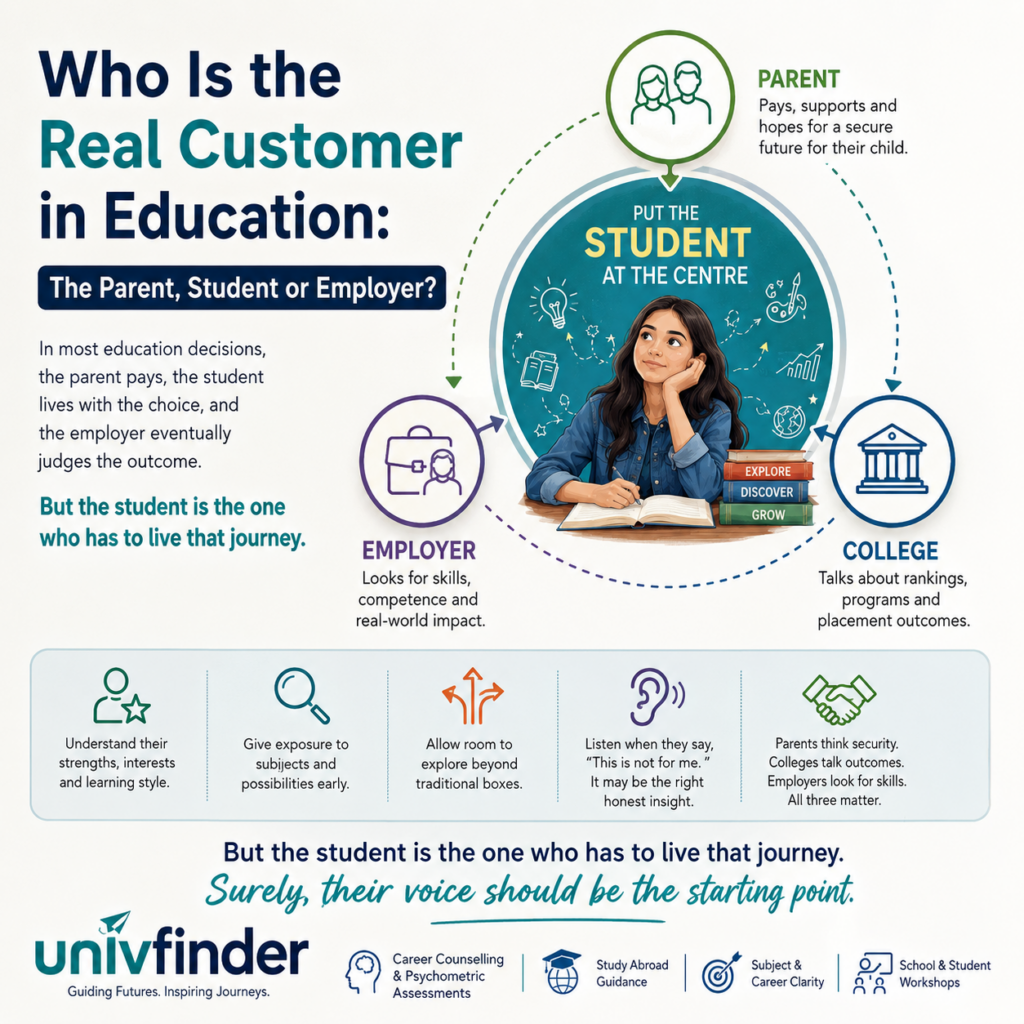
In most education decisions, the parent pays, the student lives with the choice, and the employer eventually judges the outcome. Yet somewhere between parental expectations, college rankings and placement statistics, the student’s own voice can become the quietest.
For me, putting the student at the centre has to go beyond simply asking them, “What do you want to do?”
It means helping them understand what they are naturally good at, what genuinely interests them and how they learn best. It means giving them enough exposure to different subjects and possibilities before expecting them to make choices that may shape the next several years of their lives.
It also means giving students room to explore. Someone interested in computer science may also be drawn to design or finance. A student studying economics may discover an aptitude for data. Interests do not always fit neatly into the boxes our education system creates.
And perhaps we need to listen more carefully when a student says, “This is not for me.” Sometimes that is not a lack of ambition or effort. It may simply mean that we have been looking at the wrong path.
Parents will naturally think about security. Colleges will talk about outcomes. Employers will look for skills. All three matter.
But the student is the one who has to live that journey.
Surely, their voice should be the starting point.